
+91 77009 58575
sales@nishraoverseas.com
+91 77009 58575
sales@nishraoverseas.com
Nishra Overseas LLP is a top supplier and manufacturer of Loose Pipe Flanges, which are widely utilized in a variety of industrial applications. The market offers a variety of standards for the carbon steel loose flanges. Features of Alloy Steel Loose Flanges include affordability, customization, accurate design, sturdy construction, ease of use, resistance to corrosion, and more. We offer these duplex steel loose flanges to our clients, which are renowned for their remarkable strength and long usable life. To provide a seal between the pipe and the threaded flange, these Inconel Loose Flanges taper as the tapers become closer to the same diameter.
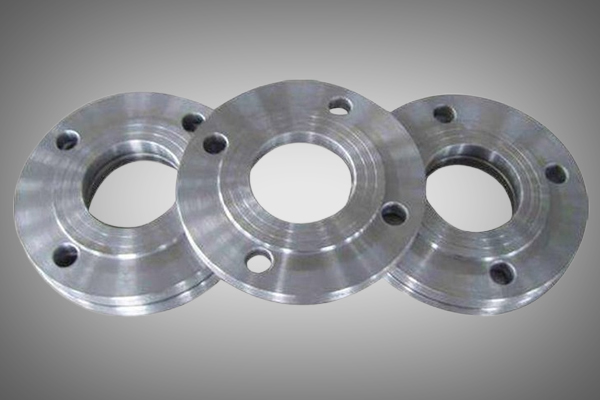
Lap joint flanges, also known as loose flanges, have a matching stub end that "inserts" into the inside of the flange. Its primary advantage is that the flange can spin to facilitate bolting hole alignment once the pipe welds to the insert stub-end. On the other hand, slip-on flanges and their stub-ends are roughly as capable of withstanding pressure as lap joint flanges. They are not appropriate in circumstances when the external loads of force are strong or fluctuating. They are advantageous when it comes to piping systems that must be disassembled frequently for inspection or to clear buildups.
Loose flanges are designed to suit elbows, valves, and practically any form of pipeline component now in use. A device called a loose flange is welded onto the end of a pipe to form part of a flanged connection. The component is formed of flat steel forging with bolt holes around the outside and an opening in the middle the size of the pipe that will be welded onto a loose flange. Depending on the use, the component can be made of stainless steel or carbon steel.
We are a Stainless Steel Loose Flange manufacturer in India, and we offer these Inconel Loose Flange, Hastelloy Loose Flange, Monel Loose Flange, Alloy 20 Loose Flange, Aluminium Loose Flange, Nickel Loose Flange, Duplex Loose Flange, Super Duplex Loose Flange, Incoloy Loose Flange, Copper Loose Flange, Copper Nickel Loose Flange, Brass Loose Flange, 254 Smo Loose Flange, and Titanium Loose Flange in all standards that are common in the world.
| Size | 1/2" (15 NB) to 48" (1200NB) |
| Standards | ANSI B16.5, ANSI B16.47 Series A & B, MSS SP44, ASA, API-605, AWWA, Custom Drawings |
| Pressure Ratings | Class 150, Class 300, Class 400, Class 600, Class 900, Class1500, Class 2500 | PN6, PN10, PN16, PN25, PN40, PN64 etc. |
| Carbon Steel Slip On Flanges/ SORF Flanges | ASTM A105/A105N, A350 LF1, LF2 CL1/CL2, LF3 CL1/CL2, A694 F42, F46, F48, F50, F52, F56, F60, F65, F70, A516.60, 65, 70 (Spectacle Blind Flange, Spacer Ring/Spade Flange), Steel RST37.2, C22.8 |
| Stainless Steel Slip On Flanges/ SORF Flanges | ASTM A182 F202, F304/304L/304H, F316/316L, F316H, F316TI, F310, F321, F904L |
| Alloy Steel Slip On Flanges/ SORF Flanges | ASTM A182 F1, F5, F9, F11, F22, F91 |
| Special Alloy Slip On Flanges/ SORF Flanges | Duplex, Super Duplex, Nickel Alloys |
| Flange Type | Flate Face (FF), Raised Face (RF), Ring Type Joint (RTJ) |
| Coating/Surface Treatment | Oil Black Paint, Anti-rust Paint, Zinc Plated, Yellow Transparent, Cold and Hot Dip Galvanized Socket Weld Flange |
| Value Added Services | CNC Machining, Customised Flanges |
| Class | 150 | 300 | 400 | 600 | 900 | 1500 | 2500 |
| Diameter - A | 30 | 38 | 38 | 38 | 38 | 38 | 43 |
| Diameter - D | 90 | 95 | 95 | 95 | 120 | 120 | 135 |
| Thickness - B | 11.2 | 14.3 | 14.3 | 14.3 | 22.3 | 22.3 | 30.2 |
| Diameter - G | 35.1 | 35.1 | 35.1 | 35.1 | 35.1 | 35.1 | 35.1 |
| Diameter - K | 60.3 | 66.7 | 66.7 | 66.7 | 82.6 | 82.6 | 88.9 |
| Height - H | 16 | 22 | 22 | 22 | 32 | 32 | 40 |
| Bolt Holes | 4 | 4 | 4 | 4 | 4 | 4 | 4 |
| Diameter - L | 15.9 | 15.9 | 15.9 | 15.9 | 22.2 | 22.2 | 22.2 |
| Stud Bolts Diameter x Length | |||||||
| Diameter (in) | 1/2 | 1/2 | 1/2 | 1/2 | 3/4 | 3/4 | 3/4 |
| Length (mm) | 55 | 65 | 75 | 75 | 110 | 110 | 120 |
| Outside Diameter ≤ 24 = 1.6 mm | > 24 = ± 3.2 mm | Inside Diameter not applicable |
| Diameter of Contact Face 1.6 mm Raised Face = ± 0.8 mm 6.35 mm Raised Face, Tongue & Groove / Male-Female = ± 0.4 mm | Outside Diameter of Hub ≤ 12 = + 2.4 mm / - 1.6 mm | ≥ 14 = ± 3.2 mm |
| Diameter of Counterbore not applicable | Drilling Bolt Circle = 1.6 mm | Bolt Hole Spacing = ± 0.8 mm Eccentricity of Bolt Circle with Respect to Facing ≤ 2½ = 0.8 mm max. | ≥ 3 = 1.6 mm max. |
| Thickness ≤ 18 = + 3.2 mm / - 0 | ≥ 20 = + 4.8 mm / - 0 | Length thru Hub ≤ 18 = + 3.2 mm / - 0.8 mm | ≥ 20 = + 4.8 mm / - 1.6 mm |
Flanges can be classified into five varieties based on how they attach to pipes: flat welded flange, butt welded flange, threaded flange, socket welded flange, and loose sleeve flange.There are several varieties of flange sealing surfaces, including projecting (RF), concave (FM), convex (M), tenon (T), groove (G), full plane (FF), and ring connection surface (RJ).
The loose flange (also known as a looper flange or a lap joint flange) is actually a combination of two flanges, as seen in the figure below:
A change in substance is a common type of connection.
Loose flange is the usage of flanges and steel rings to cover the flange at the pipe's end, allowing the flange to move.Steel rings or flanges seal surfaces and compress them.The loose sleeve flange does not make contact with the medium because it is obstructed by the steel ring or flanging.
Loose sleeve flanges are appropriate for connecting non-ferrous metals such as steel, aluminum, and stainless acid-resistant steel containers and corrosion-resistant pipes.
The loose sleeve flange is a movable flange that is typically used with water supply and drainage fittings (the most common being an expansion joint). When the manufacturer leaves the plant, there is one flange at each end of the expansion joint that is immediately attached to the bolts of the project's pipelines and equipment.
It is the type of flange with loopers.Loosening bolts are commonly used in pipes, where they can spin the pipes on both sides before being tightened.It is easy to disassemble and reassemble pipes.
| Oil and Gas Processing | Dairy and Food Processing |
| Desalination | Pesticides |
| Pulp and Paper | Sugar Factory |
| Energy industries | Power Plants |
| Ship Building | Fertilizers |
| Machine Building | Nuclear |
| Pharmaceuticals | Chemicals |
| Textile Machinery | Synthetic Fibers |
| Construction | Modern Architecture |
| Refinery & Petrochemicals | Water treatment facilities |
Every Standards have clearly requirements for steel flanges’ marking style, usually the marking words include seller’s Logo, buyer’s Logo (OEM), standard number, flange’s type, flange’s pressure, flange’s size, flange’s material, place of origin, heat number and other words for convenient to trace. If the flanges repaired by welding, it must mark on flanges showing this flange repared by welding. If the flange’s dimensions (OD, ID, PCD, Thickness, Holes number, Holes diameter, Tolerance etc) are different with the normal standard, it also must mark on flanges where it is different with normal ones. Another important place is heat number marking, it is the tracing base for every piece flange, and from the heat number we can trace to the beginning of raw material import.
Carbon Steel Loose Flange and Stainless Steel Socket Weld Flanges are delivered with or without surface protection, as determined by the manufacturer.
The company delivers Loose Flange in standard packaging, without surface protection or end protectors (caps). Special packaging, protective covers, and end protectors (caps) can be agreed upon.
 Angola
 Australia
 Austria
 Bahrain
 Belgium
 Brazil
 Canada
 Chile
Chile Denmark
 Egypt
Egypt France
 Germany
 India
India Indonesia
 Iran
Iran Israel
 Italy
Italy Japan
Japan Jordan
 Kazakhstan
 Kuwait
 Malaysia
 Maxico
 Morocco
 Netherlands
 Nigeria
 Oman
Oman Philippines
 Poland
 Qatar
Qatar Romania
 Russia
 Saudi Arabia
 Singapore
 South Africa
 South Korea
 Spain
Spain Sweden
 Switzerland
 Taiwan
 Thailand
 Turkey
 UAE
UAE UK
UK USA
USA Venezuela
 Vietnam
 Zambia